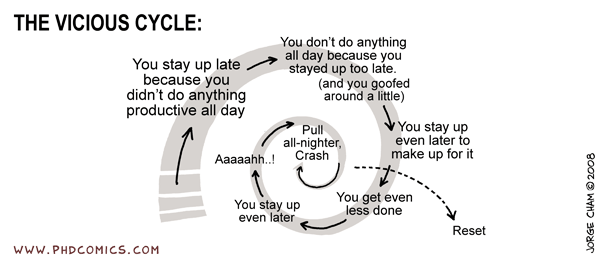
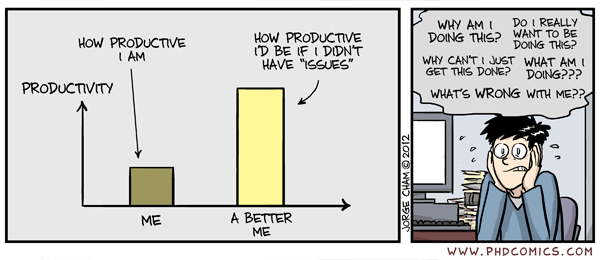
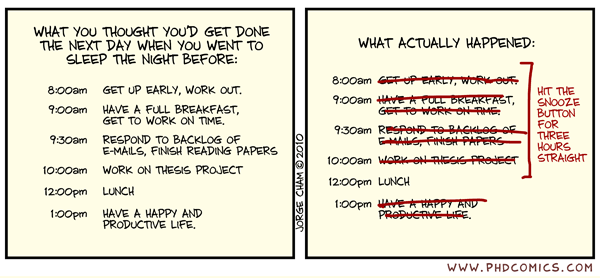
Or not. This blog just wouldn't be me if there weren't a few time management issues here and there. Regardless, the progress train rolls on. Sometimes I'm even on it. On it, running after it, or being dragged by it, I'm still going in that direction.
So how did I get here?? Interestingly, I feel in the past few years that I've discovered I was always heading in the direction of my current locomotive - I just didn't know it. I got to this crossroads by what seemed like a meandering path, but the undercurrent was there all along. When I was little, like most children, I wanted to be several things, and like most children, I didn’t just ‘like’ things, I wanted to go ahead and ‘BE’ them, because children of course do not have to stop and ask themselves what goes into ‘being’ a member of a profession. I wanted to be an artist, a doctor, an archaeologist, a biomedical engineer, a special effects technician, a criminal forensic scientist, a vet, and, in my most awesomely realistic move, a psychic (though if you fumble the word when announcing this to your family and say ‘psychotic,’ prepare to never live down the event). Ironically, I think all of these job listings were very true reflections of the things I would continue to seek later in life, even the last of the list in its childlike reflectance of my true desire to know what I should do and be confident in my decisions. It's just very interesting how we progress into the understanding, career, and outlook of our adult lives.
Artist:
The ‘artist’ notion was the first, and possibly the most immature in terms of recognizing what a profession would entail, and the notion was put aside relatively early in favor of finding a more practical career, though art as a hobby was always encouraged, and this is still a fulfilling hobby for me today.
Archaeologist:
Archaeology sprang up for a short period because I was fascinated by dinosaurs, as I think most people rightfully are at some point in their childhoods. Dinosaurs were the monsters we were allowed to believe in, and that we could actually go see in museums. Exactly what I personally found so fascinating about them might have had more to do with their structure, their physiology, their proposed movement, the way their skeletons fit together and so on, versus an interest in their history or the like - they were living animals, and I wanted to draw them and understand how they worked and why.
Special Effects Technician:
The next big idea brought me back to art, while throwing in a good deal of technology as my interests in science took off. Watching television and movies, I became interested in how the special effects were accomplished. Animatronic dogs, dinosaurs, monsters, and even people required significant artistry for the outer aesthetic effect to be achieved, while inside the robots had their own peculiar physiology, a mess of struts and bolts and wires and servo motors whose mechanics and timing all had conform to reproduce natural physiology’s effects. The marriage of the technical aspects of the structure and mechanics of these projects with the final three-dimensional artistic effect achieved appealed to me.
Forensics:
Criminal forensics was only a major interest of mine in terms of the cold cases, the reconstruction puzzle aspect, the study of marks in bone and shapes and sizes of items that allowed an animal or person or event that was gone long ago to be rebuilt. The physiology of how things connected and worked beneath the surface and how that can be disrupted was the focus of my interest.
Medicine:
From art, my first discovery, to the next three professional options, my interests were present but they lay beneath seemingly erratic career possibilities. As I grew older, these interests crystallized a bit, and the only other jobs I have ever considered were related directly to the medical field. When I was young, I loved animals and everything about them, and my ‘vet’ phase spanned a number of years. My interest in physiology and pathology and treatment was not limited to animals during this time, however. I didn’t have vet-specific books, but we did have the AMA Family Medical Guide, which at that young age was like the first leap down the rabbit hole into a world I had never seen, and which I nerdily read from cover to cover multiple times. Who needed outer space? This stuff was wild, and it was all packaged up tidily inside every person I encountered. My interest in medicine was ignited early and never faltered. My basic interest was in the biological systems of animals, and over the years I began to find that several professions could be applicable. I thought about being a doctor or a vet for years, not leaning solidly in favor of MD over DVM until high school, and the idea of medical school has remained in the back of my mind ever since.
Biomedical Engineer:
Somewhere, sometime in all of this, the newish field of biomedical engineering came into play, and its implications for medicine and technology were fascinating. It promised to integrate so many fields, so many subjects - it was a treasure trove! And perhaps here would be pure science, no politicking, no bureaucratic junk to deal with, no oversized egos crowding up the place.... ....cut me some slack, will you? So I was naive. I was in high school.
Well, after much mulling over, my decision was made, I went to college, and I entered a graduate program in biomedical engineering a few years ago. I had a period of self reflection and life direction consideration partway through the program, and I've decided both that I feel medicine is for me and that my current program was not a mistake. Strange but true. I needed to get
here. I would love to not feel like I'll be entering med school as an old fogie who is late/behind. I'd love to blend in in some ways, I suppose. But I won't, and I can't feel that I would have gotten here personally or spiritually had I just gone on to medical school because it was next on my list. And I'm incredibly thankful to be able to see that. I was wrong and yet I wasn't, weird as it may seem.
Thing is, biomedical engineering is fascinating stuff. The things we're trying to do are amazing. Medicine isn't better, but it is different, and my decision for one great medically related career over the other boils down to a couple of key items. Most people who have a passion for some sort of work, I feel, have a passion for a system. There’s a certain system that fascinates them and they want to know how it works, to know everything about it. It can be like watching paint dry to everyone else on earth, but that person will watch that system all day with the same childlike interest that prompts six-year-olds to stare at ant farms for hours, just taking in information, wondering, analyzing, and learning. Some people’s system might be the economy, the stock market, the cycle of the weather, the physics of interacting particles or bodies, the consumption and renewal of resources, population dynamics, the efficiency of a machine, the mechanics of cell migration, and the list is virtually infinite. Everyone has his system. Mine is the body. It shows in every major interest I have had for my career. Living, breathing, mobile, food-chomping masters of homeostasis. I'm interested in them all. Biomed and medicine both hold promise for these amazingly connected piles of cells. But here's the rub.
Engineers do great work for many theoretical people someday. Doctors do work for one person today. We collaborate with doctors, see patients, take data, run experiments, and at the end of the day, guess who's our baby. It's the data, the statistical analysis, the computational model. We leave the patient, his story, his treatment options, and his quality of life - HIM - after our interaction, and we focus on our baby. There is a difference in focus here.
On a related track, we many times only view a tiny piece of all these patients (or "data points"). We learn about a protein receptor on a certain type of cell in a certain subset of people, we learn about the malformed physiology of a single organ and its effects on a specific procedure, or we study a particular deficit in a certain type of speech in patients who have had injury to a given brain area. Doctors must get very specific at times, perhaps knowing how a metabolic disease works at the molecular level, and how the patient's genetic makeup helps to predispose him to such a condition, and yet at the end of the day, the doctor zooms out and looks at the whole patient, and a treatment is chosen for a whole body, a whole person. There is a difference in magnification here.
These are my two logical forks-in-the-road that I've found in trying to parse how between two fields which have such similarities I might find myself making such a definite decision. I am already looking at "my system," just a little out of focus. The only other metric I have is much less scientific. We shall term it "my mysterious spider sense." There's being interested, even excited about a field, and then there's belonging. Hard to sort out, but I can get excited, nostalgic, and many other things when viewing others in fields relating to art, or being around animals, or forensics, or cutting edge research, and yet I don't feel the urge to drop my current plans and go DO those things. I'd love to visit, but I wouldn't know the first thing about staying. Medicine invites me to stay, and while I'll continue looking for logic and testing my motives as I go, it does mean something.
So that's my background, and here I am. I need to become an amazing researcher while doing a lot of different things to prepare for the application to medical school. Loads to go, but since my last post a lot has happened. I took the MCAT, which is a great weight to have off. One beast off the list. It felt good to take that step, but it was tempered with the passing of my mother very soon afterwards. I am so sorry that I did not get to show her all the things she would have wanted to see in my life - she made it her job to pour her life into the lives of her children, and like a little child again I would love to have been able to show her so many other completed art projects with the supplies she helped me to obtain. Still, for her, I know things had been rough recently, and I am thankful for her peace. Our family shrinks, God's family grows, and her place now is without limitations. We who are still here have great opportunity to hear the call and serve every day, and I hope I can work hard and keep my vision clear so I can do that.